I had a nice little routine going here - some structure, but not so rigid that it was suffocating. But then visitor season hit, followed by major holidays, and some serious and multiple changes to my class schedule (I have to blame something, right?). I found myself a bit rudderless, and didn't really realize what was happening. Then I suddenly saw! And remembered how important it is to have purpose and structure in life. So, I made a little schedule, and a few rules.
The number one rule is: every day, say "where will I walk today?" instead of "do I have to go out for something?"
Supporting rules include basics like get up by 7:00, have a real breakfast, no more than 2 cups of coffee (that one is tough, and may very well go by the wayside), and get ready for bed by 10:00 (but actual sleep time will take care of itself).
Today was the first day of tryouts :-). Rick and I walked to Guadalupe, mainly for the walk, but also to stock up on meat at the butcher. I hadn't been there in a very long time, and never any day but Saturday. Saturday is feria day in Guadalupe, and so I used to combine that with a number of other chores - as did many other folks. And the butcher was **busy!** But on a Monday? Not so much! :-D
Once I started to think about what I could do when I go out, instead of how to accomplish everything efficiently, life got a bit nicer. No more groaning about having to go out to do a bunch of chores, no more over-stuffed shopping cart, no more saying "where did the day go?"
Showing posts with label retire. Show all posts
Showing posts with label retire. Show all posts
Monday, May 2, 2011


Wednesday, March 18, 2009
Art Workshop - Part III
 The main "event" of our Art Workshop was to start with an interesting hard surface (e.g., a piece of wood), add papier maché to all or part of it, then add water color.
 I found a piece of lumber that had been scored and banged up, and did a few sketches - the scoring reminded me of falling water, so I thought of either a waterfall or rain.


I played around with it, breaking rules right and left :), and it evolved...


See Part I and Part II.
Art Workshop - Part II
Alison got our creativity jump-started with some sketching - "the hand without looking" is a fairly typical exercise for this - probably because it works :-)

Then we tried some perspective with charcoal - mine went all caddywonkus, so I focused on just one small part of it, experimented with color and deep shadows. The idea is that every part of a picture should be interesting. Well, this is as much "interesting" as I could salvage...

Later, we went our separate ways - the idea was to go on a nature walk and find something to capture in a sketch. I went a short distance (a *very* short distance), and focused on this flower.

These leaves also caught my eye.

We tried different surfaces for papier maché - this is bamboo

Then we progressed to water colors - this definitely takes some practice!


See Part I here.

Then we tried some perspective with charcoal - mine went all caddywonkus, so I focused on just one small part of it, experimented with color and deep shadows. The idea is that every part of a picture should be interesting. Well, this is as much "interesting" as I could salvage...

Later, we went our separate ways - the idea was to go on a nature walk and find something to capture in a sketch. I went a short distance (a *very* short distance), and focused on this flower.

These leaves also caught my eye.

We tried different surfaces for papier maché - this is bamboo

Then we progressed to water colors - this definitely takes some practice!


See Part I here.
Art, and the Other Side (Art Workshop Part I)
Art, and the Other Side...
After 25 years of training and working the "engineering" side of my brain, I wanted a shot at exploring "The Other Side."
We so often think that if you are a scientist or engineer, you can't be artistic. "Creativity" seems magical, mysterious, so opposed to logic. But science and art at their best require both rules *and* flashes of insight. In science, very often the flashes provide the basis for new rules. In art, breaking the rules is often the catalyst for something amazing!
In the last 2 years, I have been absorbing a new life, allowing more creativity to creep in, but until recently, not actively pursuing art. Where I've never written for fun before, now I am. I've been experimenting (e.g., playing) with different foods and cooking methods. We've taken time specifically for "photo safaris." And I tried a new approach for learning Spanish.
But until now, I hadn't done anything structured, or specifically aimed at ART. Taking a class in some kind of art has been on my "to do" list (you can take the kid out of engineering, but you can't take the engineer out of the kid) :-) So, last weekend, I went to an ART Workshop! Alison is a gifted artist and teacher.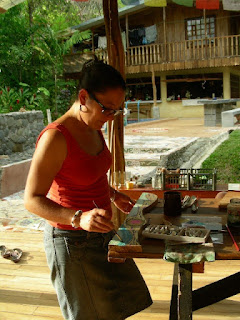
My art-self-confidence going into this was pretty low, but I decided to take a deep breath, ignore convention, and dive in! When I started talking about vague recollections of rules, Alison threw the door open - you can do this, or that, or whatever you like - wow... When some vague doubt crept in - "something is missing, or not quite right" - she was like a guide in a maze - "see how you did this here? you can try a few more like that." When I thought something worked, she was right there agreeing :-S.
The retreat in Puriscal was ideal - our small group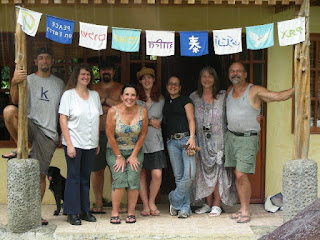 spent Friday afternoon through Monday morning completely focused on art. The retreat folks took care of us - we woke with the sun, had a leisurely cup (or two) of coffee, breakfast and wake-up conversation, then gathered in the open-air studio.
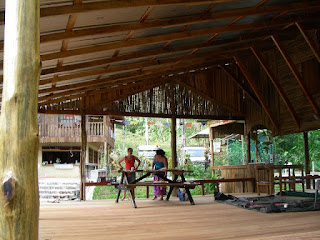 We sketched, painted, and papier machéd, continuing through a mid-morning snack, then broke for a late lunch. Usually we did some more artwork after lunch, then went for a refreshing swim, showered, and relaxed in the heat of the day. When it cooled, we went back to art, then broke for dinner, followed by fun and games. All we *had* to focus on was art!
After 25 years of training and working the "engineering" side of my brain, I wanted a shot at exploring "The Other Side."
We so often think that if you are a scientist or engineer, you can't be artistic. "Creativity" seems magical, mysterious, so opposed to logic. But science and art at their best require both rules *and* flashes of insight. In science, very often the flashes provide the basis for new rules. In art, breaking the rules is often the catalyst for something amazing!
In the last 2 years, I have been absorbing a new life, allowing more creativity to creep in, but until recently, not actively pursuing art. Where I've never written for fun before, now I am. I've been experimenting (e.g., playing) with different foods and cooking methods. We've taken time specifically for "photo safaris." And I tried a new approach for learning Spanish.
But until now, I hadn't done anything structured, or specifically aimed at ART. Taking a class in some kind of art has been on my "to do" list (you can take the kid out of engineering, but you can't take the engineer out of the kid) :-) So, last weekend, I went to an ART Workshop! Alison is a gifted artist and teacher.

My art-self-confidence going into this was pretty low, but I decided to take a deep breath, ignore convention, and dive in! When I started talking about vague recollections of rules, Alison threw the door open - you can do this, or that, or whatever you like - wow... When some vague doubt crept in - "something is missing, or not quite right" - she was like a guide in a maze - "see how you did this here? you can try a few more like that." When I thought something worked, she was right there agreeing :-S.
The retreat in Puriscal was ideal - our small group
 spent Friday afternoon through Monday morning completely focused on art. The retreat folks took care of us - we woke with the sun, had a leisurely cup (or two) of coffee, breakfast and wake-up conversation, then gathered in the open-air studio.
 We sketched, painted, and papier machéd, continuing through a mid-morning snack, then broke for a late lunch. Usually we did some more artwork after lunch, then went for a refreshing swim, showered, and relaxed in the heat of the day. When it cooled, we went back to art, then broke for dinner, followed by fun and games. All we *had* to focus on was art!
Thursday, December 18, 2008
Alajuela Living: Pros and Cons
 I’ve been putting off posting a review of living in Alajuela, and I’ve finally figured out why. I didn’t want to write anything negative about it! Our rule for town reviews is to write pros *and* cons, and Alajuela has always felt good – I didn’t want to dig for bad.
Well, since our plan for Costa Rica is to live in several towns for several months each before deciding where to settle down, we have to try to stand back; we have to toss the rose-colored glasses. I struggled with the Orosí review as well.
During our visits, we have been trying to keep in mind that we are looking for the best place for us - this is difficult because it is so easy to focus on the positive and ignore or downplay any negatives. It is easy to say "Oh, we can live without that," etc.
 We lived in Alajuela for 4 months, from the end of the rainy season until the end of the dry season. When we left, we kept it on our list as a possibility. We let our impressions settle for a while, then came up with this list of Pros and Cons.
Costa Rica update
- Affordable: While still affordable, CR has gotten more expensive.
- Safety: We believe CR is getting more violent.
- Year-round living: We have our residency (no change in outlook)
- Religion: We’ve seen many saints’ processionals, we’ve met more people who attend church, but are not fanatics. However, Alajuela central park often had yelling bible-thumpers. (no change in outlook)
- Interesting (culture, activities): There are many universities, museums, theaters, and a symphony (but mostly only in San José). Music is a big part of life. Cowboys (sabañeros) are alive and well, contributing fancy horse-back riding, topes, and rodeos to the scene. A question we still have is how easy is it to get involved?
- Dangerous diseases (few or none, please): Dengue fever is on the rise.
- Medical care (accessible and good): We bought into the state-run medical insurance ($61/month for both of us). There are several excellent private and public hospitals, but the best ones are in San José. I had surgery – so far, so good.
- Water – must be drinkable (bottled water is available, but too expensive and bothersome). Neither of us could drink the tap water without some degree of discomfort; we ended up using bottled or filtered water for drinking and for making soup and coffee. This has been true in every town so far, so we have decided that we will need a water filter for anywhere we live in Costa Rica. We found a faucet-mounted water filter at EPA in Escazú, and brought a large supply of the replacement filters from the states.
Alajuela Overview (see here - http://www.fallingrain.com/world/CS/index.html - for data**): Alajuela is a large city – it is the second largest city in Costa Rica, and has about 72,000 people. It is the city nearest the “San José” airport. It is about 17 km West of San José (560,000 people). It is in the central valley - a bit lower in elevation (918 m / 3015 ft) than San José (1146 m / 3763 ft).
Pro:
- Friendly people – Alajuela has some of the friendliest people! On our nearly daily walks, we exchange smiles and greetings with many people. We have met and become friends with many people there. Alajuela is on par with small towns in its friendliness. We felt much more welcomed than in Grecia (for example).
- We fit in (purely a feeling): We are comfortable walking around Alajuela. The neighbourhoods make us feel energized.
- Very few of the helpful people have ulterior motives (e.g., they genuinely want to help; they are not just trying to sell you something).
- Alajuela is not a tourist town, but we saw a lot of travellers.
- A Central Park – Alajuela has an excellent central park, as well as many others. We regularly walked through 3 on our short trip to the bus station; all are beautiful and relaxing.
- Excellent central market; a lot to chose from. However, we didn’t shop there often enough to develop a sense of what were fair prices. There is also a weekly farmers market, verdurerías, and super markets.
- Good doctors are available in town; there are both a clinic and a hospital. It is a decent bus ride (20-45 minutes) to San José for private hospitals and major public hospitals.
- Easy to find things – it is a large town, and the provincial capital, so most items are available (shoemakers, tailors, spices, appliances, furniture, bedding, “unusual” medications). Specialty items (CPAP) are available in San José.
- Many ethnic restaurants – Chinese, Columbian, Peruvian, Italian, Tex-Mex…
- (Pro for Julie) ¨Good¨ climate - not too humid, a little bit too hot. “Hot” was 84-87 inside. A fan helped, and Julie got used to the heat. At the peak-heat time of day, there was usually a nice breeze, so going outside (like to a park:)) helped. Our apartment got pretty cold at night – 67 was not uncommon (a thicker blanket would have been welcome).
Con:
- (Con for Rick) Climate – Rick needs a cooler elevation (perhaps 1200-1300 meters or higher); Alajuela’s elevation is about 900, and is on the hot side. Temperatures in the upper 80s were common. It was too hot for Rick.
- Somewhat difficult to have a horse nearby, but there is a stable. We didn’t see any riders.
- Not as affordable as smaller towns – rent was double; food was more expensive.
- Few opportunities for social interactions and meeting new people. There were few events for such a large town (although the soccer stadium had games and a few concerts). Limited to “hang-outs” such as Jalapeño’s, and private parties.
- Able to find housing within 10 blocks of the center of town – we found an apartment that was 5 blocks from the central park, but it is more expensive than in smaller towns. It was also hard to find!
- Feels safe (emphasis in addition to above list) – safe enough that a woman can walk around alone at night? I used to do this in Alajuela, but now I would think twice about going by myself after dark.
- Community – need to be part of an artist/music/movie community (how far away is too far?) – near UCR, or other center. Didn’t find this in Alajuela.
- Entertainment / Mental Stimulation – we need a town with more than churches and bars (of course, parks are very entertaining) – Difficult to find.
** use some caution when looking at populations – this site counts the population within a 7 km circle. So, large towns are under-represented and small towns get more population than actually live in town.
Monday, May 12, 2008
May 12, 2008 – Changing Plans
Anyone who has planned anything knows that the result rarely resembles the plan. Even Sci-Fi battle planners have a saying – “All plans are just a starting point; when the battle starts, anything goes.”
Well, our future isn’t exactly a battle, but I laugh when I look at our first plan for retiring and moving to Costa Rica. I still have the timeline on the front page of my notebook. We were going to sell the house before I quit (hah!), store most of our stuff and make perhaps two shipments (that was before we knew the cost), permanently move (live year-round) to Costa Rica by the end of 2007, and finish shipping anything we decided we wanted by the end of 2008. I *did* quit on schedule, but only because I had three different dates as options.
Even before committing it to paper, we went back and forth about shipping stuff. We were going to go with just suitcases and purchase whatever we needed when we got there. We were going to take just a few things. We were going to take our bed. And our double recliner. And our DVDs… I don’t think we’ll really know what we’re taking until we actually do it. Meanwhile, we have some furniture in Costa Rica and some in the states.
We kept putting off selling the house – too much else going on. Probably also some subconscious need to hang on. Well, now it is a nasty time to try selling – foreclosure auctions right and left. So, we’re going to rent it out for a while instead. This decision had probably the most effect on our recent life. Instead of moving completely and immediately to Costa Rica, we have spent most of the last year on two separate long trips. We did get to experience two different ways of living – in a small town (Orosí), and in a large town (Alajuela). But we had to deal with “occupying” two houses in two different countries. This is not for the faint of heart. It is definitely not for us in the long run. At least we don’t have a house in Costa Rica to worry about while we are in the states. The house in the states is a bit easier to watch out for. We have friendly, concerned neighbors; we have family nearby. When our fence blew down in California, our neighbor took care of everything, and my folks drove down just in case. We returned to a dead car battery and some air in the water pipes, but everything else was pretty much ship-shape. Folks who have a house in Costa Rica have to worry about keeping it occupied while they are gone. We just moved out :).
Our thoughts have meandered around the idea of whether to live in Costa Rica year-round or not. At first, it was no question – of course we would! That is the whole idea! Then we started thinking. Uh-oh. More plans fly out the window. Here is another thing that I am sure we won’t really know which we’ll do until we do it. (I had to re-read that sentence twice – yikes!) Since we are rentistas, we will definitely be in Costa Rica for at least 4 months out of each year (this is required in order to maintain that type of residency). That leaves a *lot* of time to explore the rest of the world – or explore more of Costa Rica, of course. We *have* decided (finally) that this year we will be in Costa Rica most or all of the time.
We are still on-plan for our time in Costa Rica. That plan is to live for several months in different places around Costa Rica, looking for just the right place. It is a little crazy, looking for the most perfect piece of paradise *in* paradise. But it is kinda fun too. I think that if we just closed our eyes and pointed at a map of Costa Rica, we’d find a great place to live – we’d be perfectly happy. But neither of us has had the perfect freedom to choose before. The choice has always been made *for* us by jobs, schools, etc – perfectly :(.
Sunday, April 13, 2008
April 13, 2008 – Stop!
Why is it that coming back to the states is so stressful? It used to be that coming home from a vacation engendered a deep sigh of contentment – we had a lovely trip, but home is where you can relax. I suppose part of it is that we are disassociating from our home in California, and embracing more aspects of Costa Rica. Part of it has to be that when we left for Costa Rica, we also left behind some responsibilities – and they were still here when we got back. But I think the biggest factor is that when we are in Costa Rica, we don’t have the same sense of urgency. When we are in California, we put so much pressure on ourselves to get things done, *and* we have to do it on a schedule.
After just 3 weeks back, we were climbing the walls – stressed out, but oddly bored. So we said “stop!” – took a deep breath, and chucked the schedule. After all, our time really *is* our own…
Just to complete our de-stress, we went *dancing!* We met 17 years ago during a ballroom dancing lesson. We finally went back :~?. Not only was it great, I think it may actually have been more fun than the first time.
As for my schedule – it will be a while before I post our review of living in Alajuela. We like to take a bit of time to let our thoughts and impressions settle, anyway.
Wednesday, April 2, 2008
April 2, 2008 – USA Health Insurance (Rant)
Once in a while, I gotta rant. This time, it’s about how fouled up the health insurance situation is in the states.
Most places that I have worked touted themselves as being on the cutting edge of health insurance reform (I’d say health insurance gimmicks). Most of these changes resulted in the employee paying part of the premium.
When we first heard about this, it was called “Flexible benefits” because you got to choose your health plan, and balance that choice against how much more you would pay each month. This soon became the norm.
Another place I worked pushed even more. At first, they provided you a way to measure your health via a questionnaire. You could do this or not – it was supposedly anonymous (but we suspicious types never really believe that). The next year, you got a discount on your premium if you completed the health questionnaire. The next step was this – if your health measurement indicated you had a problem or a health risk, you got a discount if you did something about it. For example, if you smoked, you got a discount if you joined a stop-smoking program – the discount applied even if the program didn’t work, and you still smoked. Likewise for a weight-loss program. The final step (although there is probably still something that can be squeezed out), was that you only got the discount if the problem got better – you stopped smoking, lost weight, etc. Written this way, you could argue that your health is important to them, and that they are providing incentives for you to get healthier. Cynics would say something a bit different.
If you tie in the insurance changes with the cultural effects of professional life in the Silicon Valley, you get a potent mixture. Life revolves around work. Stress builds up. Health suffers. The attitude is “Oh you’re sick? Did you get that report done?” You see co-workers coming to work with fevers, still working outrageous hours, because they have deadlines and expectations. You get a culture clash when you find out that people in other parts of the company go to their child’s soccer game in the middle of the afternoon (Don’t these people have any sense of priorities!?!?). THEN you find out that you’re expected to join programs to reduce the health problems largely caused by spending so much time at work. And just when are you supposed to go to these programs? So you end up resenting the system and paying more for your health insurance. And you aren’t any healthier…
So, this was just a low-level irritation for me for decades until I asked my health insurer about gastric bypass surgery. Then the irony hit full force. You have health insurance, which you pay more for because of a weight problem. Certainly, you do things like diet and exercise to help it. But there is no way you are going to go to a doctor multiple times per month for three (3) years for a medically supervised program – how can you do this when you don’t even have enough time in the day to get a full night’s sleep? Since retiring, I now had the time and the insurance (18 months of COBRA) to really do something about it. But the insurance won’t cover the surgery unless I have proof of a medically supervised weight-loss program lasting 3 years. This is not what I call encouraging better health. This is more like looking like we care while not paying for surgery.
If you read this, you know that I went ahead with the surgery. I had it done in Costa Rica. It cost about a third of what it would have cost in the states. It cost me about double what I would have paid out of pocket if insurance had kicked in. It didn't - I'm healthier without the insurance.
I realize that my situation is *nothing* compared to so many others. I don’t have cancer, I don’t need a transplant, I don’t need anything experimental. But this is just one more item showing how manipulated we are.
Friday, March 14, 2008
March 11, 2008 – Health Focus in Costa Rica
I’ve just passed my first year of retirement! It’s hard to believe that much time has gone by. One of the main things I wanted to do was to focus more on my health. I have found that my method for most of my life is to focus on one or two things at a time – everything else takes a back seat. I had been spending almost all my effort on work, often without leaving enough time in the day to even get a full night’s sleep (let alone all the other important aspects of life). Well, I was determined to change that. So, I spent the first few months just relaxing; downsizing my stress. We spent a few months in Costa Rica Costa Rica 20 pounds and knocked the bejeezes out of my blood tests - over 50 points off my cholesterol level, 40 off triglycerides, and almost 20 off glucose levels. Of course, doing the laundry by hand helped, and I can´t entirely discount the effects (beneficial?) of food poisoning…
But I knew from past experience that I could only go so far, and at least a partial rebound was likely in my future – and I also had so much more to fix. So, we took the plunge, and I had gastric bypass surgery in
Rick was uneasy with the idea of my having surgery – let´s face it, it is a serious undertaking. But then he thought about this – our bodies have evolved to be efficient, and to store fat for the times when we need more fuel than we can take in. In these times, that is just not very often… So, if your body is not working the way you need it to, there is nothing wrong with changing your body. It´s still a bit scary, of course…
The long-term effects for most people is that you lose 80% of the excess weight. Some people gain some back, but not all of it. This is a permanent change, and basically forces a change to your eating habits. The other options for bariatric surgery were either not permanent, or were not as positive.
In the short-term, most of the excess weight is lost in the first 6 months. Something called ¨malabsorption¨ continues for 3-5 years – this is where the vitamins are not absorbed completely by the body (you need to take supplements).
One interesting side-effect of this surgery is that your glucose levels stabilize *immediately* - if you have Type 2 diabetes or glucose intolerance, 90% of the time the surgery itself cures this. This is because the section of intestine that triggers glucose over-production is bypassed – so no more triggering. This has led to a modified surgery for people who have Type 2 diabetes without a weight problem. They have been doing this in
Some of the differences in health care here in
- Everything happens at its own pace, so sometimes appointments take hours (much of it waiting). But of course, that has happened plenty of time in the states too. However, most of the time, appointments were spot on.
- I had a consultation with the surgeon ($48), and left with his cell phone number – and instructions to call at any time. Over the course of the surgery and recovery, we must have called him over a dozen times – each time, he was happy to hear from us (really? Well, it seemed like it…).
- Once we got the surgery go-ahead (passed all the pre-operation tests), we paid for the procedure. This included all the visits to all the doctors, all the tests, and over a week´s worth of prescriptions. It also included a follow-up endoscopy at 6 months.
The question of insurance requires its own entry…
Thursday, December 13, 2007
August 04, 2007 - Costa Rica, But Which Town?
So, we know more about what we are looking for (see my last post), now what? We made a list of towns to check out. We put together this list from word-of-mouth, maps, and driving through towns on our way elsewhere. It is not carved in stone; we can add towns at any point.
Next, we visit! That is possibly the best part. Some towns we go to for the day via the bus, some we stay in a hotel for a few days, some we homestay with a local family, and some we rent an apartment or house for a few months. I believe you get the best information and feel for a town by first doing a homestay (for at least 2 weeks), then renting your own place for a month or two. But, of course, some places just don’t grab you enough to make that kind of investment.
This is also difficult. The objective is essentially to find fault with the towns on your list, and determine whether they go on the “no, not for us” list or the “possibly us, check more” list. It is soooo easy at this point to “overlook” something, or downgrade the importance of a criterion – usually, we get overwhelmed by how nice the people are.
Also, I think the way you get to know the town colors your judgment. If you stayed at a hotel in Orosí, you would never know that the lady who lives across the street from the supermarket sews for a living. You wouldn’t know that there actually *is* a place to get your nails done, and a place to get a massage. If you take a day trip to Sarchí, you wouldn’t know that it has a botanical garden, but if you got off the bus too early  , you would get a great introduction to the wood-working business.
It is a strange thing to blog about as well, since this is purely *our* list. I know that many of the towns that we will have on our “no, not for us” list are where others have put down roots – perfect for them. So, disclaimers apply – here are our lists.
Towns Currently Under Consideration
· Alajuela
· Atenas
· Barvas
· Cartago
· Heredia
· Naranjo
· Palmares
· Sarchí
· San Antonio Belén
· San Isidro del General
· San Pedro
· San Ramon
· Santa Bárbara de Heredia
· Tres Rios
· Zarcero
Towns that are “not for us”
· Grecia
·
· Monteverde / Santa Elena
· Nosara
· Orosí
· Paraíso
· Sámara
· San José
· San José de
August 04, 2007 - Costa Rica Decision Details
When we first investigated how to retire early, and where we could do this, we made a list of “needs” and “wants” – we’ve both worked on trade studies in our technical careers, so this was nerdy second nature to us ;).
Our original list, and how
Needs
· Affordable (can we live there on less than $30,000 / year):
· Safety (laws, enforcement, history, stability, how does it feel): CR has been a stable democracy for over a century, with one 2-week civil war in 1948. It has no army; the government saw that the main purpose served by the neighboring armies was to control their countries, not to protect them. The people are welcoming and friendly. They are generally happy and caring. The country gets earthquakes, but they build for them (and we are used to this phenomenon, being from
· Able to live there year-round (weather, visas, residency):
· Religion (tolerant, doesn’t dominate life and laws, the people are not fanatical): Catholicism is
Wants (weighted and scored)
· Language (English, or able to learn fairly easily): Weight = 9, Score = 7. Spanish is spoken in
· Easy to travel “home”: Weight = 7, Score = 8. It is physically possible to drive to
· Easy to establish residency: Weight = 9, Score = 8. The Association of Residents of Costa Rica (ARCR) is an organization that helps people immigrate. The information is easy to get, and the immigration laws are such that we could do it without too much risk.
· We fit in (purely feeling): Weight = 9, Score = 8. This is almost simple gut reaction. Are we comfortable walking around the towns? Do we feel energized or depressed? Is it likely we can adjust through all the phases of the culture shock we know is coming?
· Interesting (culture, activities): Weight = 8, Score = 8.
· Dangerous diseases (few or none, please): Weight = 7. Score = 7. I am including snakes and bug bites here. There are something like 20 different venomous snakes in
· Medical care (accessible and good): Weight = 8, Score = 9. Any resident may buy into the state-run medical insurance ($60/month for both of us. It is less if you are older – yes, *older* - the extra that younger people pay goes towards a pension.). There are several excellent private and public hospitals, but the best ones are in
· Expatriate community (available, supportive): Weight = 8, Score = 8. There are many centers for ex-pat support. These include ARCR, internet groups, and local hang-outs in most towns (and they are amazingly easy to find).
Since visiting and living in different towns in
· A
· A Central Market – variety is the spice of life
· Friendly people, with few ulterior motives (this is difficult to determine, and even more difficult to agree on)
· Able to find housing within 10 blocks of the center of town (5 is even better, as we’re still trying to go car-less)
· Feels safe (emphasis in addition to above list) – not necessarily all places in a town (most towns of size anywhere will have *some* “bad” parts), but safe enough that a woman can walk around alone at night
· Climate – cooler elevations (1200-
· Community – need to be part of an artist/music/movie community (how far away is too far?) – near UCR, or other center
· Entertainment / Mental Stimulation – we need a town with more than churches and bars (of course, parks are very entertaining)
· Water – must be drinkable (bottled water is available, but too expensive and bothersome)
Wednesday, December 12, 2007
February 03, 2007 - why Costa Rica?
A lot of people ask "why
Rick and I wanted to find a way to spend more time together, so about 2 years ago, we started seriously researching early retirement. We got all kinds of books on how to retire on a shoestring. We'd been watching our budget for years, so thankfully we knew our habits.
It became obvious pretty quickly that we couldn't do it if we stayed anywhere in the
So, we started looking outside the
We've been several more times, each with the same result - this place is for us!
This year, we're on our way!
January 21, 2007 - A New Start
What are some of the things you do when you make a life-change?
Certainly, I think about keeping in touch with my friends and family. For me, that is easier said than done. Hence, the blog...
In general, I am lousy at keeping in touch - it is not something I am happy about, and so am looking for ways to fix the situation. I recently lost my web domain - I hadn't kept it up anyway - so, the email address that people have used for years is goooone.
So what is this life change?
Well, I gave notice at work this week. As of March 2, I am officially retired!
As I am 43, this cause a number dirty looks and comments. Among them: "loser!" (Steve), "I hate you" (Tim), "but you aren't even grey!" (Bret - thanks for that one ;))
Rick (my husband) and I are moving to
... and share
Subscribe to:
Posts (Atom)

