It seems that for us, it is the end of one era, and the beginning of a new one. We have spent 6 years enjoying our time, figuring out how to live in Costa Rica. Now, fewer and fewer things are new to us, and so there are fewer things that seem worth blogging about. Some of our earlier observations and experiences are no longer current, and we don't always notice some of the things that we would have, if we had had our old "new" eyes.
While it was nice for a while to simply live - to be settled - we had gotten used to having challenges! Without those, life became a little stagnant. So, we're shaking things up (again) :-). Last year, we experimented with travel and with contract work. It seems to suit us, so we'll spend more of each year outside of Costa Rica. Costa Rica will still be home, and we'll maintain our residency here, but we'll spend a good amount of time elsewhere.
We're Vagabonds again!
Showing posts with label newstart. Show all posts
Showing posts with label newstart. Show all posts
Saturday, February 25, 2012


Monday, August 15, 2011
The Fast Lane
When things happen, they sure can happen FAST! This time last week, I was thinking through my options for the next few weeks, considering taking another intensive French class, Tango lessons, painting more, and investigating possible contracts. Then, my first-choice activity, a contract to work for a few months, seemed to be more definite. Then, it was! And things started hopping :-)
August:
August:
- 10 Wednesday: The contract looked promising; reserved airline ticket, good for 24 hrs (got the last non-red-eye flight)
- 11 Thursday: We reached an agreement; the new company started the ball rolling; I bought the airline ticket
- 12 Friday: The contracting agency contacted me and sent forms; I started collecting info
- 13 Saturday: I filled in and printed forms; went out to dinner to celebrate :-)
- 14 Sunday: Completed/confirmed forms, faxed to contracting agency (17 pages!)
- 15 Monday: Confirmed contracting agency received documents; asked follow-up questions, completed application
- 16 Tuesday: Breathe, pack, take final Tango lesson :-(
- 17 Wednesday: Fly to California
- 18 Thursday: Take drug test
- 19 Friday: Test results known (earliest possible date)
- 20 Saturday: Visit, pack
- 21 Sunday through Wednesday: Drive to Iowa (3,000 kilometers)
- 25 Thursday: Start work
Sunday, August 14, 2011
What Do You Want From Life?
Well, ok - that sounds a little more "inspirational" than I expected. But it is a fundamental question.
When we first decided to move to Costa Rica, we put together a plan for *how* to do it, but for my part, I purposely left the "what" part vague. I knew it would take a few years to figure out life here, and I wanted to give that a chance without being sidetracked by "things I said I gotta do."
When you are first finding out how something works, even the negatives can be viewed as valuable learning experiences. Take the feria, for example. Your first trips are full of excitement - you see how to get there (follow the empty carts), you watch for cultural norms (everyone calls you "reina"), and you discover pricing and quality differences. You're exhausted because you meander and buy too much, but that is easy to ignore when you think of how to use these newly discovered foods. After a while, you know who to go to for the best broccoli, and you spend more time chit-chatting, and less time comparison shopping.
But shortly after you become comfortable with something, it's no longer exciting. You know enough about how to do it that you aren't challenged. It can become boring, and even perhaps an irritating chore. If too many of your activities make that turn, your life is in trouble.
Now, after several years, most of my daily life is in that "comfort zone." I've weeded out a few items that were heading towards the "irritating chore" category, but I find I'm searching for excitement, for a challenge, for a new purpose.
In my search for "different," I don't want to lose sight of our original purpose - find a way to spend more time together. Secondarily, we wanted to give ourselves the opportunity to experience... whatever strikes us! To find out what else might interest us, and delve in! What I *have* discovered is that I enjoy so many things, and each new activity builds a skill. There are also aspects that are just plain hard and frustrating, but ultimately rewarding. I am finding out more about myself. One thing that I pretty much knew, but which was made obvious to me is that I very much enjoy engineering - the work, the problem-solving, the pure focus, the geek-jokes, and the community.
I thought about working here in Costa Rica, and maybe that will be something in my future. But I know that if I did that, a lot of things would have to change. It would impact my life here, and not all for the better. When I pick up a painting from the framers, and it takes me an entire hour to do so, I have to wonder how in the world working Ticos survive! I see the long line of people waiting for the bus to work at 4:30 in the morning, and I don't even have to wonder for a second if I would want to do that (that would be "no!"). It simply takes a lot longer to do anything here. When you aren't working full-time, you can usually deal with that. So, if I did work here, it would have to be part-time. The intriguing aspect of working here would be that I would see a whole different side of the culture. I got a hint of that by taking classes, and it would be interesting to experience more. So, for now, I won't toss the idea completely aside.
What I have decided to do is to keep Costa Rica as a home base, mix in some travel to explore more of the world, but take contracts for software engineering elsewhere. I think this will keep my Costa Rica life pleasant and relaxing, with plenty of time to explore the "other" life, and still provide the excitement and challenge (in manageable bursts) of work. No one can predict the future, but this is a plan I can enjoy following :-)
When we first decided to move to Costa Rica, we put together a plan for *how* to do it, but for my part, I purposely left the "what" part vague. I knew it would take a few years to figure out life here, and I wanted to give that a chance without being sidetracked by "things I said I gotta do."
When you are first finding out how something works, even the negatives can be viewed as valuable learning experiences. Take the feria, for example. Your first trips are full of excitement - you see how to get there (follow the empty carts), you watch for cultural norms (everyone calls you "reina"), and you discover pricing and quality differences. You're exhausted because you meander and buy too much, but that is easy to ignore when you think of how to use these newly discovered foods. After a while, you know who to go to for the best broccoli, and you spend more time chit-chatting, and less time comparison shopping.
But shortly after you become comfortable with something, it's no longer exciting. You know enough about how to do it that you aren't challenged. It can become boring, and even perhaps an irritating chore. If too many of your activities make that turn, your life is in trouble.
Now, after several years, most of my daily life is in that "comfort zone." I've weeded out a few items that were heading towards the "irritating chore" category, but I find I'm searching for excitement, for a challenge, for a new purpose.
In my search for "different," I don't want to lose sight of our original purpose - find a way to spend more time together. Secondarily, we wanted to give ourselves the opportunity to experience... whatever strikes us! To find out what else might interest us, and delve in! What I *have* discovered is that I enjoy so many things, and each new activity builds a skill. There are also aspects that are just plain hard and frustrating, but ultimately rewarding. I am finding out more about myself. One thing that I pretty much knew, but which was made obvious to me is that I very much enjoy engineering - the work, the problem-solving, the pure focus, the geek-jokes, and the community.
I thought about working here in Costa Rica, and maybe that will be something in my future. But I know that if I did that, a lot of things would have to change. It would impact my life here, and not all for the better. When I pick up a painting from the framers, and it takes me an entire hour to do so, I have to wonder how in the world working Ticos survive! I see the long line of people waiting for the bus to work at 4:30 in the morning, and I don't even have to wonder for a second if I would want to do that (that would be "no!"). It simply takes a lot longer to do anything here. When you aren't working full-time, you can usually deal with that. So, if I did work here, it would have to be part-time. The intriguing aspect of working here would be that I would see a whole different side of the culture. I got a hint of that by taking classes, and it would be interesting to experience more. So, for now, I won't toss the idea completely aside.
What I have decided to do is to keep Costa Rica as a home base, mix in some travel to explore more of the world, but take contracts for software engineering elsewhere. I think this will keep my Costa Rica life pleasant and relaxing, with plenty of time to explore the "other" life, and still provide the excitement and challenge (in manageable bursts) of work. No one can predict the future, but this is a plan I can enjoy following :-)
Saturday, August 13, 2011
Back to Painting :-)
I finally finished a couple more paintings, and got them back from the framers - I've branched out to abstracts
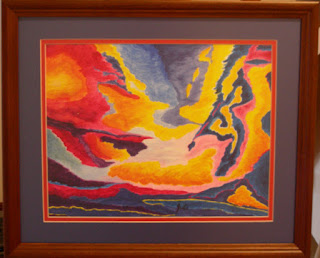
and non-tropical flowers


and non-tropical flowers

Wednesday, June 22, 2011
'Cause That's My Bag
I had been using an old "swag" bag more and more here. The bag was the perfect size and weight for all sorts of things: it fit my school books, I could easily add some shopping to the end of my day, it was a great over-night bag, and it even fit my art supplies without crumpling them! But, it wasn't the prettiest thing :-) and one of the straps was safety-pinned on.
So, I decided the time had come to replace it. I got a half meter of heavy drape material at Yamuni, and started sewing. I ended up adding a few frills - now I just have to get used to the idea that I can abuse this bag too, even though it is quite a bit prettier :-D.
 This version has a button-down flap (adjustable to a second button you can't see at the top), an umbrella-holder on the right side (also handy for other items I want to keep separate and easy to access), two inside pockets, and adjustable straps with quick-release clips. I used nearly every bit of the 1/2 meter of cloth.
Directions:
So, I decided the time had come to replace it. I got a half meter of heavy drape material at Yamuni, and started sewing. I ended up adding a few frills - now I just have to get used to the idea that I can abuse this bag too, even though it is quite a bit prettier :-D.

Directions:
- Straighten and fold the material, making the fold become the bottom of the bag.
- cut the main bag piece 24" long x 17 3/4" wide.
- cut 2 straps 4" x 32"
- cut 1 flap 5" x 10 1/2"
- cut 1 pocket 5" x 10 1/2"
- Overcast all edges
- Sew the sides of the bag, leaving gaps for the umbrella-holder:
- 5 inches from the top, stitch around a sturdy elastic hairband
- 5 inches below that, stitch around 2 gaps, leaving space for a long shoelace
- Note: use a satin stitch around the gaps for strength
- Form the bottom of the bag: fold the bottom of the side seam into a triangle, so that the end of the seam forms the tip. Each side is 2 3/4" - Stitch perpendicular* to the side-seam. Repeat on the other side.
- Sew the straps:
- fold one long edge 1/2 inch and stitch
- add batting if desired, but only to the center section of the strap (not the ends, since this will make them too thick)
- fold the other long edge to abut the first edge and stitch
- fold the long edges together and stitch
- Form the top of the bag and attach straps:
- place the straps 5 inches in from the sides
- fold the top edge of the bag under and stitch, securing the straps in place*
- fold the top edge of the bag 1 inch and stitch
- topstitch along the top edge, again including the straps
- stitch an "X" at each strap to further secure it to the top of the bag
- Add the pockets
- fold under all edges of the pocket material and stitch.
- determine where you want them - I put mine at the top edge, mostly along the back of the bag, but also opposite the umbrella holder, straddling the side seam a bit. I wanted easy access for my phone and change purse, and that is the side that will be handiest for me.
- topstitch pocket to the bag around 3 sides (leaving top open, of course).
- stitch a separator up the middle to form two pockets - you can vary the size
- Add the flap
- fold under all edges of the flap material and stitch - at one end, form a clipped-triangle
- make a button hole at the triangle end
- center the other end of the flap at the top of the bag (this is now the "back" of the bag) and stitch
- sew one button at the fully-closed position, and another at the top of the bag (for when the bag is very full)
- Add the clips to the straps (this is why you don't want batting at the ends - the straps will be too thick to fit through the clips)
- determine where you want your clips, and cut the straps
- overcast each end
- pull the strap through the non-adjustable end of the clip and stitch
- pull the other end of the strap through the adjustable end of the clip
Sunday, May 15, 2011
My Just-Sew Story
I've decided to get back into sewing a bit - I have my sewing machine here after all! I used to do quite a bit, including prom dresses, and my wedding dress. But all that was in the states, where the art of sewing is managed a bit differently. There, you walk into a store armed with your measurements and some idea of what you want to make. You pour over the pattern catalogs, collect your chosen pattern from the many drawers full, and read the "ingredients" list. Then you browse for the perfect material, and swing by the notions section for matching thread, zippers, lace, and all the trimmings. You take your pile to the counter, they measure out the amount of material stated on your pattern, give you a smidgen extra (although I saw less and less of this as time went on), and you're on your way!
Here, just to get off to a good start, there are no patterns. Already you know it's going to be tough. So, you start with some piece of clothing you have, but would like to change somewhat. I chose a pair of shorts - I wear these almost constantly at home, and they're wearing out here and there. I decided to make a pattern from the "sample" so I would have it for another time - I also think it is easier to modify and double-check measurements with a paper pattern. I found that the paper the grocery store uses to wrap glass wine bottles works pretty well - especially if you've just opened that bottle, and have a glass of it handy. I drew out my pattern, but forgot a seam allowance. I discovered this in time, and so was able to tape an extension on :-). I also discovered that I did *not* in fact have my french curve with me. So I just winged it.
Next, I needed material! I went to my neighborhood Yamuni - a department store that has a nice selection of material. They had a large selection of curtain/drape material, some fleece and toweling, some suiting, and some basic blends. It is very difficult to find cotton or silk, and wool is just not to be dreamt of. Not that I *want* wool in the tropics, but these are things you need to be aware of. Since I have no handy-dandy pattern telling me how much material to get, I'm back to winging it - I get a meter. Turns out it was on sale, so that it cost me all of $1.25...
However! Yamuni has no notions! Here in Costa Rica, they have a type of store called a "pasamanería" - *this* is where you go for all your sewing notions! Not knowing (yet!) where one of these is, and knowing that I have some basic notions in my kit, I feel like I'm in good shape. Can you say "famous last words?"
I got my material washed and straightened, lined up and cut out. Remember those nice instructions included in a pattern? Sew this part first, line up these notches, start in the center, etc. Hah! Fortunately, I remembered a lot. I sewed a few seams, then pinned up the sides, and tried on my pseudo-shorts. Looked good, but I want to adjust a thing or two. In the end, they do the job, but there is an entire list of "oopses:"
- I wanted to use the selvage, but after adjusting the seam allowance, the selvage shows.
- When I clipped the excess material from the inseam, I snagged the leg. Sigh. Now it's patched and zigzagged; doesn't show :-) but I know it's there.
- I added enough to the pockets to account for the waist, but not enough for the stitching - Pockets are now definitely just for looks, since my hand won't quite fit.
- I was careful to keep the embellishment on one side from flipping, but the other side... bent.
- When I measured the sample, the back curved up at the waist. When I put the new shorts together, it didn't really work that way. An easy adjustment to make :-)
- At the leg, the two halves *almost* line up at the hem. Also easy to fix.
- I knew I didn't have enough blue thread for the whole project, so I went with the white thread I had. I got to the final hem, and ran out! Fortunately, I had enough bobbin thread, and I could work it so that it was what showed :-)
Not bad for a prototype...
Here, just to get off to a good start, there are no patterns. Already you know it's going to be tough. So, you start with some piece of clothing you have, but would like to change somewhat. I chose a pair of shorts - I wear these almost constantly at home, and they're wearing out here and there. I decided to make a pattern from the "sample" so I would have it for another time - I also think it is easier to modify and double-check measurements with a paper pattern. I found that the paper the grocery store uses to wrap glass wine bottles works pretty well - especially if you've just opened that bottle, and have a glass of it handy. I drew out my pattern, but forgot a seam allowance. I discovered this in time, and so was able to tape an extension on :-). I also discovered that I did *not* in fact have my french curve with me. So I just winged it.
Next, I needed material! I went to my neighborhood Yamuni - a department store that has a nice selection of material. They had a large selection of curtain/drape material, some fleece and toweling, some suiting, and some basic blends. It is very difficult to find cotton or silk, and wool is just not to be dreamt of. Not that I *want* wool in the tropics, but these are things you need to be aware of. Since I have no handy-dandy pattern telling me how much material to get, I'm back to winging it - I get a meter. Turns out it was on sale, so that it cost me all of $1.25...
However! Yamuni has no notions! Here in Costa Rica, they have a type of store called a "pasamanería" - *this* is where you go for all your sewing notions! Not knowing (yet!) where one of these is, and knowing that I have some basic notions in my kit, I feel like I'm in good shape. Can you say "famous last words?"
I got my material washed and straightened, lined up and cut out. Remember those nice instructions included in a pattern? Sew this part first, line up these notches, start in the center, etc. Hah! Fortunately, I remembered a lot. I sewed a few seams, then pinned up the sides, and tried on my pseudo-shorts. Looked good, but I want to adjust a thing or two. In the end, they do the job, but there is an entire list of "oopses:"
- I wanted to use the selvage, but after adjusting the seam allowance, the selvage shows.
- When I clipped the excess material from the inseam, I snagged the leg. Sigh. Now it's patched and zigzagged; doesn't show :-) but I know it's there.
- I added enough to the pockets to account for the waist, but not enough for the stitching - Pockets are now definitely just for looks, since my hand won't quite fit.
- I was careful to keep the embellishment on one side from flipping, but the other side... bent.
- When I measured the sample, the back curved up at the waist. When I put the new shorts together, it didn't really work that way. An easy adjustment to make :-)
- At the leg, the two halves *almost* line up at the hem. Also easy to fix.
- I knew I didn't have enough blue thread for the whole project, so I went with the white thread I had. I got to the final hem, and ran out! Fortunately, I had enough bobbin thread, and I could work it so that it was what showed :-)
Not bad for a prototype...
Tuesday, March 29, 2011
If I Had a Nickle...
If I had a nickle for every time I planned to do something in Costa Rica, and didn't, I could retire to a tropical paradise. Hey... Wait a minute!


Friday, March 25, 2011
University of Costa Rica - Getting Plugged In
This weekend is the UCR Expo, three days of "getting to know your local University!" It's something like a combination of a fiesta, feria, and open house - there are dozens of food and craft booths, sellers of all things Costa Rican, many workshops and information centers, and half a dozen stages presenting music, dancing, martial arts demonstrations, and work-out regimes.
This morning, we strolled the few blocks from our house and wandered around. We had a few things in mind that we wanted to see, but pretty quickly found much more to do. We had walked through the campus many times (it makes a nice short-cut to many places we go), but hadn't really stopped to find out more than a smattering of what was there. This time, the only real purpose was to do just that - discover what the campus had to offer.
Some snapshots:
UCR is using and promoting a lot of free software, including using it as part of the coursework. There was a room full of demonstrations, and the first one we encountered was a CD burner for Ubuntu! Rick quickly got passed to the experts in video and audio editing, and got a nice demonstration of the free-ware available. He came away with a *lot* of information, and was *very* encouraged! (csl-tec.softwarelibrecr.org)
Well.... Since Rick had such luck, I finally screwed up my courage and approached an expositionista in the pottery/ceramics tent. She was *lovely!* We talked about the School of Art - what types of art are taught (painting, ceramics, wood sculpture, etc!), and - most importantly, how I could join a class here and there without being a full-time student on a career path! I had heard that people 56 years and older could audit classes (no placement exams, could be part-time), and I knew several full-time "regular" students, but I had never heard how someone in the middle (like me) could attend a class or two. Opportunities for getting involved at UCR is one of the main attractions for living where we do! So, now I'm a step closer :-)
Of course, no open-house is complete without *food!* We got a nice big chunk of 100% pure cocoa from a woman who made it herself, on her Finca Loroco in Talamanca. Then we got a jar of cas pulp from the executive chef of Ay, Que Rico! from Heredia. He had several other pulps and sauces, and we had a nice foodie moment talking about how to use them :-). Earlier, I had seen interesting items like pejibaye flour - I'll probably go back for that...
------- contact info --------
Free software sites:
www.softwarelibrecr.org
www.softwarelibre.ca
www.drupal-centroamerica.org
www.crubuntu.org
www.linuxcostarica.com
www.softwarelibre.ucr.ac.cr
www.alternativa.una.ac.cr
Escuela Artes Plásticas
www.ucr.ac.cr
http://artesplasticas.ucr.ac.cr/
Lilliana (for info on matriculation, session dates, what to do, etc)
2511.4467
2511.4031
Finca Loroco: fincaloroco@gmail.com
Dirección 300 m hacia Carretera a las Cataratas, Volio, Talamanca. Familia Moreno Vargas
fax: 506.2751.0283
Ay, Que Rico!
Luis Mathieu M.
Chef Ejecutivo
8829.3464, 2262.2744
ayquericocateringcr@gmail.com
www.ayquericorestaurante.es.tl
Urb. Boruca 1, Mercedes Norte, Heredia
This morning, we strolled the few blocks from our house and wandered around. We had a few things in mind that we wanted to see, but pretty quickly found much more to do. We had walked through the campus many times (it makes a nice short-cut to many places we go), but hadn't really stopped to find out more than a smattering of what was there. This time, the only real purpose was to do just that - discover what the campus had to offer.
Some snapshots:
- posters touting studying science abroad (a lot of opportunities in Italy!)
- a new-to-us cafeteria (near the music building, and so we saw some musicians hanging out, playing)
- an even better short-cut :-)
- a lively soccer game
- even more sculptures
UCR is using and promoting a lot of free software, including using it as part of the coursework. There was a room full of demonstrations, and the first one we encountered was a CD burner for Ubuntu! Rick quickly got passed to the experts in video and audio editing, and got a nice demonstration of the free-ware available. He came away with a *lot* of information, and was *very* encouraged! (csl-tec.softwarelibrecr.org)
Well.... Since Rick had such luck, I finally screwed up my courage and approached an expositionista in the pottery/ceramics tent. She was *lovely!* We talked about the School of Art - what types of art are taught (painting, ceramics, wood sculpture, etc!), and - most importantly, how I could join a class here and there without being a full-time student on a career path! I had heard that people 56 years and older could audit classes (no placement exams, could be part-time), and I knew several full-time "regular" students, but I had never heard how someone in the middle (like me) could attend a class or two. Opportunities for getting involved at UCR is one of the main attractions for living where we do! So, now I'm a step closer :-)
Of course, no open-house is complete without *food!* We got a nice big chunk of 100% pure cocoa from a woman who made it herself, on her Finca Loroco in Talamanca. Then we got a jar of cas pulp from the executive chef of Ay, Que Rico! from Heredia. He had several other pulps and sauces, and we had a nice foodie moment talking about how to use them :-). Earlier, I had seen interesting items like pejibaye flour - I'll probably go back for that...
------- contact info --------
Free software sites:
www.softwarelibrecr.org
www.softwarelibre.ca
www.drupal-centroamerica.org
www.crubuntu.org
www.linuxcostarica.com
www.softwarelibre.ucr.ac.cr
www.alternativa.una.ac.cr
Escuela Artes Plásticas
www.ucr.ac.cr
http://artesplasticas.ucr.ac.cr/
Lilliana (for info on matriculation, session dates, what to do, etc)
2511.4467
2511.4031
Finca Loroco: fincaloroco@gmail.com
Dirección 300 m hacia Carretera a las Cataratas, Volio, Talamanca. Familia Moreno Vargas
fax: 506.2751.0283
Ay, Que Rico!
Luis Mathieu M.
Chef Ejecutivo
8829.3464, 2262.2744
ayquericocateringcr@gmail.com
www.ayquericorestaurante.es.tl
Urb. Boruca 1, Mercedes Norte, Heredia
Sunday, March 6, 2011
Something New...
I'm taking a hiatus from painting while visitors are here - we're roaming the countryside :-). My last complete painting was something very new for me (at the urging of Rick, the sky-guy).


Wednesday, February 2, 2011
Summer Time, and the Livin' is Easy
The livin' might be easy, but the time is *flying* by! It seems like just a few days ago, it was rainy season. We've just been poking along, making plans in the distance, but sticking pretty close to home.
Now, all of a sudden, with summer in full bloom, school is right around the corner! In two weeks, my French classes start again (hah! less than 2 weeks now, since it took me a while to actually write that down!). Then, a short week later, VISITOR season starts! (that's a big "YAY," by the way)
This just can't be - I have too many emails piled up that need some kind of answer, a French book to finish reading, a few essays I was supposed to write (we'll just rip out that little piece of my to-do list), and "just a few" visits to friends that haven't even gotten planned. Time to get crackin'...
Now, all of a sudden, with summer in full bloom, school is right around the corner! In two weeks, my French classes start again (hah! less than 2 weeks now, since it took me a while to actually write that down!). Then, a short week later, VISITOR season starts! (that's a big "YAY," by the way)
This just can't be - I have too many emails piled up that need some kind of answer, a French book to finish reading, a few essays I was supposed to write (we'll just rip out that little piece of my to-do list), and "just a few" visits to friends that haven't even gotten planned. Time to get crackin'...
Friday, December 24, 2010
A New One!
Look what I brought home!
 I started this in *October!* I finally finished it - now it needs framing. But I think I'll keep it on my wall for a little while before I cart it off again.
PS - this one is acrylic on canvas, 16" x 20"
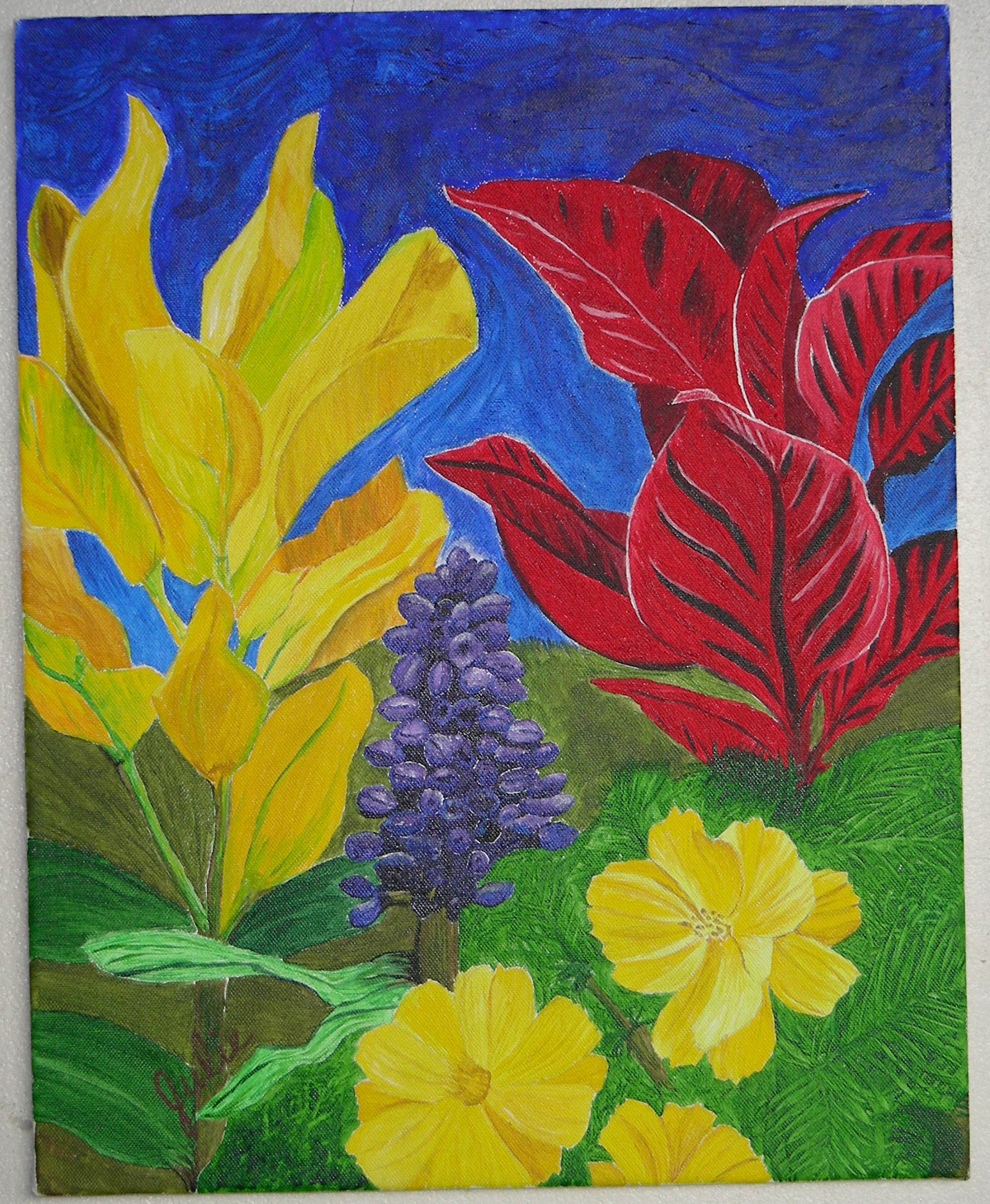
PS - this one is acrylic on canvas, 16" x 20"
Wednesday, December 22, 2010
Framed!
I've been framed! Well, a couple of my paintings have been, anyway ;-)
My new life now includes painting sessions with my "painting buddy" - I feel I can say that I paint now because I go to friend Linda's place almost every Friday, and we spend the day just painting - it's officially one of those pass-times that get me into "the zone," and nothing else enters my sphere of awareness - how wonderful to have found another of those :-D.
The nice thing is that I have an awful lot of bare walls to fill up, and Rick seems to like what I paint. I looked around a bit for a framing place. I had no idea of what was a reasonable cost, and what could be done with a painting, so it took some looking, asking and comparing. At the high end was an art gallery in San José - they would mat and frame with glass my small painting for c20,000 (about $40). I kept that in mind, and checked in (and tried to check in) at a couple of other places. I finally took my painting to:
Miró Galeria y Enmarcado
San Pedro, Barrio La Garanja,
de Ferreteréa El Mar 100 sur y 25 este
2280-0672 / 2283-8081
They quoted c9,000 ($18) for double-mat, non-glare glass and frame. They even have a discount for artists who are framing their own work! Hmmm - I left my painting there, and picked it up a week later.
 I decided to leave my next one too! (The larger one was c15,000, and ready in 2 weeks because of the Xmas season.)

My new life now includes painting sessions with my "painting buddy" - I feel I can say that I paint now because I go to friend Linda's place almost every Friday, and we spend the day just painting - it's officially one of those pass-times that get me into "the zone," and nothing else enters my sphere of awareness - how wonderful to have found another of those :-D.
The nice thing is that I have an awful lot of bare walls to fill up, and Rick seems to like what I paint. I looked around a bit for a framing place. I had no idea of what was a reasonable cost, and what could be done with a painting, so it took some looking, asking and comparing. At the high end was an art gallery in San José - they would mat and frame with glass my small painting for c20,000 (about $40). I kept that in mind, and checked in (and tried to check in) at a couple of other places. I finally took my painting to:
Miró Galeria y Enmarcado
San Pedro, Barrio La Garanja,
de Ferreteréa El Mar 100 sur y 25 este
2280-0672 / 2283-8081
They quoted c9,000 ($18) for double-mat, non-glare glass and frame. They even have a discount for artists who are framing their own work! Hmmm - I left my painting there, and picked it up a week later.


Friday, December 17, 2010
Paradise Redeemed
Most of this week, it has been colder than aich-ee-double-toothpicks! ehm, in the Nordic sense, that is. But today! Ahhh today! Paradise has redeemed itself! The air was soft again, the sun was out, and my sweater found its way into my carry bag and stayed there.
On top of all that lovely-weather-ness, my day was pretty much paradisaical from a "what's happening" point of view too :-). My morning was slow - trying experiments with showers, coffee, breakfast, etc to try to break some nasty headache / acidic stomach issues. Not so lovely, but the great thing is that we have the ability to actually try these different things - not possible in our old life...
Then, while I'm waiting for my bus, my fellow bus-waiter and I start chatting... in Spanish, and I'm holding my own! Turns out, we are heading to nearly the same place - and it's two buses away! So, we sit together, talking more, then walk to our next bus, still talking, then ride out... Ultimately, I'm speaking Spanish with someone, making more sense than not, understanding almost everything, for almost 2 hours - I feel all warm and fuzzy :-).
Next, I catch my 3rd bus of the morning, alone this time, but with my new French book. I make it through a couple of pages before my stop (hmmm, that's half an hour, if you're wondering how fast I can read). I absorbed more summer sun for a few minutes, then my paint-buddy picked me up, we went back to her house, had an *excellent* lunch, and then painted for the afternoon!
I finished (and signed - very important to do) my canvas, a collage of flowers, then started on a new project. I'm trying out acrylics on broadcloth - I plan to stitch it to some vanes, and have my very own hand-fan; just in time for summer :-)
The weather held all afternoon and into the evening - I caught my return buses without too much delay (I suppose I've just gotten used to my neighborhood bus being perpetually late - sigh). Rick had some wine chilling, so we got caught up over a nice glass or two, had dinner, watched a couple of TV shows, and relaxed! Oh yeah, brownies for dessert! :-D.
Does it get much better than that?
On top of all that lovely-weather-ness, my day was pretty much paradisaical from a "what's happening" point of view too :-). My morning was slow - trying experiments with showers, coffee, breakfast, etc to try to break some nasty headache / acidic stomach issues. Not so lovely, but the great thing is that we have the ability to actually try these different things - not possible in our old life...
Then, while I'm waiting for my bus, my fellow bus-waiter and I start chatting... in Spanish, and I'm holding my own! Turns out, we are heading to nearly the same place - and it's two buses away! So, we sit together, talking more, then walk to our next bus, still talking, then ride out... Ultimately, I'm speaking Spanish with someone, making more sense than not, understanding almost everything, for almost 2 hours - I feel all warm and fuzzy :-).
Next, I catch my 3rd bus of the morning, alone this time, but with my new French book. I make it through a couple of pages before my stop (hmmm, that's half an hour, if you're wondering how fast I can read). I absorbed more summer sun for a few minutes, then my paint-buddy picked me up, we went back to her house, had an *excellent* lunch, and then painted for the afternoon!
I finished (and signed - very important to do) my canvas, a collage of flowers, then started on a new project. I'm trying out acrylics on broadcloth - I plan to stitch it to some vanes, and have my very own hand-fan; just in time for summer :-)
The weather held all afternoon and into the evening - I caught my return buses without too much delay (I suppose I've just gotten used to my neighborhood bus being perpetually late - sigh). Rick had some wine chilling, so we got caught up over a nice glass or two, had dinner, watched a couple of TV shows, and relaxed! Oh yeah, brownies for dessert! :-D.
Does it get much better than that?
Sunday, September 12, 2010
Breakfast at Our House
One thing that has changed drastically with moving to Costa Rica from the fast lane of Silicon Valley is *Breakfast!* This used to be a quick canned shake on the road, followed by coffee at my desk. Ugh.
Now? Most mornings we have a full, cooked breakfast, eaten together - much better!

Veggie Scramble
Chop the following:
- 1/2 onion
- 1/4 sweet red chili
- 1/2 piece palmito and/or carrot (~2-3 inches)
- 1/2 zucchini (or some other green vegetable, such as broccoli, chayote, or green beans)
Heat about a tablespoon of oil in a non-stick skillet, add the veggies, and cook until done. I like mine browned and somewhat caramelized.

Break 3 eggs into a bowl, and remove one yolk (either throw it away or keep for another purpose). Add the following, and stir well:
- a bit of water or sour cream (about 2 tablespoons)
- black pepper
- powdered ginger
- basil
- any other favorite spices (Rick likes garlic)
- cheese en polvo - that is, a dry cheese, powdered or grated (optional)
Add the eggs to the veggies, and reduce the heat. Stir until done. Remove to a plate and cover until ready to serve.
Sides
Heat a shallow layer of oil in the pan, then add sliced maduro. Cook on low until browned, then flip to brown the other side.
Meanwhile, slice tomato (sprinkle with basil or pesto sauce), avocado, and fruit.
If cheese is not in the scramble, slice some queso fresco (aka tierno, aka new cheese)
For a *very* hearty breakfast, add some Gallo Pinto :-)
Toss everything on 2 plates, serve with bread and jam, and sometimes sour cream and Lizano. And don't forget the coffee!
Budget tip - throwing away egg yolks is still cheaper than buying prepared egg whites! But stay tuned for a crème brûlée recipe (ok, so it's Pots de Crème) :-)
Now? Most mornings we have a full, cooked breakfast, eaten together - much better!

Veggie Scramble
Chop the following:
- 1/2 onion
- 1/4 sweet red chili
- 1/2 piece palmito and/or carrot (~2-3 inches)
- 1/2 zucchini (or some other green vegetable, such as broccoli, chayote, or green beans)
Heat about a tablespoon of oil in a non-stick skillet, add the veggies, and cook until done. I like mine browned and somewhat caramelized.

Break 3 eggs into a bowl, and remove one yolk (either throw it away or keep for another purpose). Add the following, and stir well:
- a bit of water or sour cream (about 2 tablespoons)
- black pepper
- powdered ginger
- basil
- any other favorite spices (Rick likes garlic)
- cheese en polvo - that is, a dry cheese, powdered or grated (optional)
Add the eggs to the veggies, and reduce the heat. Stir until done. Remove to a plate and cover until ready to serve.
Sides
Heat a shallow layer of oil in the pan, then add sliced maduro. Cook on low until browned, then flip to brown the other side.
Meanwhile, slice tomato (sprinkle with basil or pesto sauce), avocado, and fruit.
If cheese is not in the scramble, slice some queso fresco (aka tierno, aka new cheese)
For a *very* hearty breakfast, add some Gallo Pinto :-)
Toss everything on 2 plates, serve with bread and jam, and sometimes sour cream and Lizano. And don't forget the coffee!
Budget tip - throwing away egg yolks is still cheaper than buying prepared egg whites! But stay tuned for a crème brûlée recipe (ok, so it's Pots de Crème) :-)
Living in Costa Rica - Best and Worst (for now)
People often want to know "the worst" and "the best" about living in Costa Rica - unfortunately, this list changes, depending on what kind of day you're having :-S.
So, my list for today is all about the unexpected...
Three of the best things about living in Costa Rica:
- sharing a moment with others while waiting for or riding a bus. Or shopping. Or watching a tope. I love it that so many people get a gleam in their eye, for no apparent reason. Then a smile, then sometimes a comment about the line, or the weather, or whatever, that sometimes leads to a lovely conversation.
- the fiestas that never seem to stop! The new year starts with the end of Christmas fiestas, then continues through school summer break. Then fiestas leading up to lent. You would expect things to quiet down during lent, but noooo! It's *summer,* and March is a *huge* month for weddings, horse fairs, and other celebrations. Then Easter! It is the biggest week for family vacations to the beach, as well as religious parades. May slows down a bit, but there are still plenty of fiestas. Then June and July have major events - Guanacaste day, and San Juan's little summer. August sees patron days in San Ramon and several other cities. The entire month of September is Independence Month, with clean buildings and parks, flags and buntings streaming, parades and fireworks. October and November seem to build up to Christmas, and December is chock full of fiestas!
- the bus system! Every time I really think about this, I have to laugh at myself. I used to practically *live* in my car - drove since the age of 9; I never used a bus (except for school, and then only until I could legally drive). Now, in Costa Rica, I have yet to drive a car. And I get a special thrill out of finding a new way to get somewhere by bus. So call me weird.
Three of the worst things about living in Costa Rica:
- news from USA. More and more, I find that news from the states is just plain depressing. The rest of the world seems so much more sane by comparison. But that might be because I am less vested in the details of the rest of the world.
- cherries and blueberries. Unattainable at a reasonable price, and even if you could bring yourself to pay $25 for a handful, you could only do this for a very short time each year. Mitigated by luscious, year-round mangoes :-)
- that uncomfortable feeling when you think you should know what to do in a situation, but you don't. When and how do you invite someone to coffee? What do you do to thank someone for an invitation? How closely do you calculate time spent on a job, and therefore determine pay? What hints are you missing? It's a minefield...
These are some of the things that were unexpected - let's not forget that the original reasons for even investigating Costa Rica as a place to live still hold:
- We can live (really live) together, as we like, spending real time together
- Medical care is excellent and affordable
and the expected difficulties:
- culture shock - yes, it still attacks, but less frequently, and less severely. And it is more recognizable each time, and therefore more easily dealt with.
- safety, and the necessary suspicion that goes with it - this is still hard to accept and live with, but it is becoming a more natural part of life. I'm telling myself that is a good thing.
So, my list for today is all about the unexpected...
Three of the best things about living in Costa Rica:
- sharing a moment with others while waiting for or riding a bus. Or shopping. Or watching a tope. I love it that so many people get a gleam in their eye, for no apparent reason. Then a smile, then sometimes a comment about the line, or the weather, or whatever, that sometimes leads to a lovely conversation.
- the fiestas that never seem to stop! The new year starts with the end of Christmas fiestas, then continues through school summer break. Then fiestas leading up to lent. You would expect things to quiet down during lent, but noooo! It's *summer,* and March is a *huge* month for weddings, horse fairs, and other celebrations. Then Easter! It is the biggest week for family vacations to the beach, as well as religious parades. May slows down a bit, but there are still plenty of fiestas. Then June and July have major events - Guanacaste day, and San Juan's little summer. August sees patron days in San Ramon and several other cities. The entire month of September is Independence Month, with clean buildings and parks, flags and buntings streaming, parades and fireworks. October and November seem to build up to Christmas, and December is chock full of fiestas!
- the bus system! Every time I really think about this, I have to laugh at myself. I used to practically *live* in my car - drove since the age of 9; I never used a bus (except for school, and then only until I could legally drive). Now, in Costa Rica, I have yet to drive a car. And I get a special thrill out of finding a new way to get somewhere by bus. So call me weird.
Three of the worst things about living in Costa Rica:
- news from USA. More and more, I find that news from the states is just plain depressing. The rest of the world seems so much more sane by comparison. But that might be because I am less vested in the details of the rest of the world.
- cherries and blueberries. Unattainable at a reasonable price, and even if you could bring yourself to pay $25 for a handful, you could only do this for a very short time each year. Mitigated by luscious, year-round mangoes :-)
- that uncomfortable feeling when you think you should know what to do in a situation, but you don't. When and how do you invite someone to coffee? What do you do to thank someone for an invitation? How closely do you calculate time spent on a job, and therefore determine pay? What hints are you missing? It's a minefield...
These are some of the things that were unexpected - let's not forget that the original reasons for even investigating Costa Rica as a place to live still hold:
- We can live (really live) together, as we like, spending real time together
- Medical care is excellent and affordable
and the expected difficulties:
- culture shock - yes, it still attacks, but less frequently, and less severely. And it is more recognizable each time, and therefore more easily dealt with.
- safety, and the necessary suspicion that goes with it - this is still hard to accept and live with, but it is becoming a more natural part of life. I'm telling myself that is a good thing.
Wednesday, March 18, 2009
Art Workshop - Part III
 The main "event" of our Art Workshop was to start with an interesting hard surface (e.g., a piece of wood), add papier maché to all or part of it, then add water color.
 I found a piece of lumber that had been scored and banged up, and did a few sketches - the scoring reminded me of falling water, so I thought of either a waterfall or rain.


I played around with it, breaking rules right and left :), and it evolved...


See Part I and Part II.
Art Workshop - Part II
Alison got our creativity jump-started with some sketching - "the hand without looking" is a fairly typical exercise for this - probably because it works :-)

Then we tried some perspective with charcoal - mine went all caddywonkus, so I focused on just one small part of it, experimented with color and deep shadows. The idea is that every part of a picture should be interesting. Well, this is as much "interesting" as I could salvage...

Later, we went our separate ways - the idea was to go on a nature walk and find something to capture in a sketch. I went a short distance (a *very* short distance), and focused on this flower.

These leaves also caught my eye.

We tried different surfaces for papier maché - this is bamboo

Then we progressed to water colors - this definitely takes some practice!


See Part I here.

Then we tried some perspective with charcoal - mine went all caddywonkus, so I focused on just one small part of it, experimented with color and deep shadows. The idea is that every part of a picture should be interesting. Well, this is as much "interesting" as I could salvage...

Later, we went our separate ways - the idea was to go on a nature walk and find something to capture in a sketch. I went a short distance (a *very* short distance), and focused on this flower.

These leaves also caught my eye.

We tried different surfaces for papier maché - this is bamboo

Then we progressed to water colors - this definitely takes some practice!


See Part I here.
Art, and the Other Side (Art Workshop Part I)
Art, and the Other Side...
After 25 years of training and working the "engineering" side of my brain, I wanted a shot at exploring "The Other Side."
We so often think that if you are a scientist or engineer, you can't be artistic. "Creativity" seems magical, mysterious, so opposed to logic. But science and art at their best require both rules *and* flashes of insight. In science, very often the flashes provide the basis for new rules. In art, breaking the rules is often the catalyst for something amazing!
In the last 2 years, I have been absorbing a new life, allowing more creativity to creep in, but until recently, not actively pursuing art. Where I've never written for fun before, now I am. I've been experimenting (e.g., playing) with different foods and cooking methods. We've taken time specifically for "photo safaris." And I tried a new approach for learning Spanish.
But until now, I hadn't done anything structured, or specifically aimed at ART. Taking a class in some kind of art has been on my "to do" list (you can take the kid out of engineering, but you can't take the engineer out of the kid) :-) So, last weekend, I went to an ART Workshop! Alison is a gifted artist and teacher.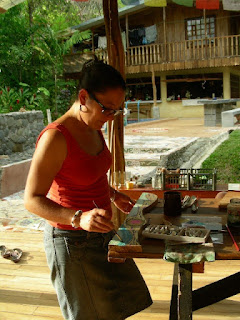
My art-self-confidence going into this was pretty low, but I decided to take a deep breath, ignore convention, and dive in! When I started talking about vague recollections of rules, Alison threw the door open - you can do this, or that, or whatever you like - wow... When some vague doubt crept in - "something is missing, or not quite right" - she was like a guide in a maze - "see how you did this here? you can try a few more like that." When I thought something worked, she was right there agreeing :-S.
The retreat in Puriscal was ideal - our small group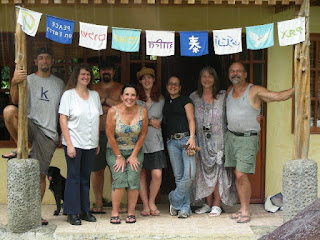 spent Friday afternoon through Monday morning completely focused on art. The retreat folks took care of us - we woke with the sun, had a leisurely cup (or two) of coffee, breakfast and wake-up conversation, then gathered in the open-air studio.
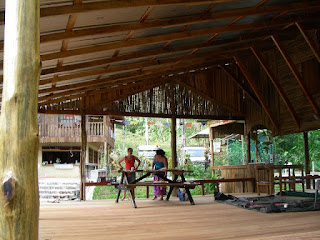 We sketched, painted, and papier machéd, continuing through a mid-morning snack, then broke for a late lunch. Usually we did some more artwork after lunch, then went for a refreshing swim, showered, and relaxed in the heat of the day. When it cooled, we went back to art, then broke for dinner, followed by fun and games. All we *had* to focus on was art!
After 25 years of training and working the "engineering" side of my brain, I wanted a shot at exploring "The Other Side."
We so often think that if you are a scientist or engineer, you can't be artistic. "Creativity" seems magical, mysterious, so opposed to logic. But science and art at their best require both rules *and* flashes of insight. In science, very often the flashes provide the basis for new rules. In art, breaking the rules is often the catalyst for something amazing!
In the last 2 years, I have been absorbing a new life, allowing more creativity to creep in, but until recently, not actively pursuing art. Where I've never written for fun before, now I am. I've been experimenting (e.g., playing) with different foods and cooking methods. We've taken time specifically for "photo safaris." And I tried a new approach for learning Spanish.
But until now, I hadn't done anything structured, or specifically aimed at ART. Taking a class in some kind of art has been on my "to do" list (you can take the kid out of engineering, but you can't take the engineer out of the kid) :-) So, last weekend, I went to an ART Workshop! Alison is a gifted artist and teacher.

My art-self-confidence going into this was pretty low, but I decided to take a deep breath, ignore convention, and dive in! When I started talking about vague recollections of rules, Alison threw the door open - you can do this, or that, or whatever you like - wow... When some vague doubt crept in - "something is missing, or not quite right" - she was like a guide in a maze - "see how you did this here? you can try a few more like that." When I thought something worked, she was right there agreeing :-S.
The retreat in Puriscal was ideal - our small group
 spent Friday afternoon through Monday morning completely focused on art. The retreat folks took care of us - we woke with the sun, had a leisurely cup (or two) of coffee, breakfast and wake-up conversation, then gathered in the open-air studio.
 We sketched, painted, and papier machéd, continuing through a mid-morning snack, then broke for a late lunch. Usually we did some more artwork after lunch, then went for a refreshing swim, showered, and relaxed in the heat of the day. When it cooled, we went back to art, then broke for dinner, followed by fun and games. All we *had* to focus on was art!
Thursday, December 18, 2008
Alajuela Living: Pros and Cons
 I’ve been putting off posting a review of living in Alajuela, and I’ve finally figured out why. I didn’t want to write anything negative about it! Our rule for town reviews is to write pros *and* cons, and Alajuela has always felt good – I didn’t want to dig for bad.
Well, since our plan for Costa Rica is to live in several towns for several months each before deciding where to settle down, we have to try to stand back; we have to toss the rose-colored glasses. I struggled with the Orosí review as well.
During our visits, we have been trying to keep in mind that we are looking for the best place for us - this is difficult because it is so easy to focus on the positive and ignore or downplay any negatives. It is easy to say "Oh, we can live without that," etc.
 We lived in Alajuela for 4 months, from the end of the rainy season until the end of the dry season. When we left, we kept it on our list as a possibility. We let our impressions settle for a while, then came up with this list of Pros and Cons.
Costa Rica update
- Affordable: While still affordable, CR has gotten more expensive.
- Safety: We believe CR is getting more violent.
- Year-round living: We have our residency (no change in outlook)
- Religion: We’ve seen many saints’ processionals, we’ve met more people who attend church, but are not fanatics. However, Alajuela central park often had yelling bible-thumpers. (no change in outlook)
- Interesting (culture, activities): There are many universities, museums, theaters, and a symphony (but mostly only in San José). Music is a big part of life. Cowboys (sabañeros) are alive and well, contributing fancy horse-back riding, topes, and rodeos to the scene. A question we still have is how easy is it to get involved?
- Dangerous diseases (few or none, please): Dengue fever is on the rise.
- Medical care (accessible and good): We bought into the state-run medical insurance ($61/month for both of us). There are several excellent private and public hospitals, but the best ones are in San José. I had surgery – so far, so good.
- Water – must be drinkable (bottled water is available, but too expensive and bothersome). Neither of us could drink the tap water without some degree of discomfort; we ended up using bottled or filtered water for drinking and for making soup and coffee. This has been true in every town so far, so we have decided that we will need a water filter for anywhere we live in Costa Rica. We found a faucet-mounted water filter at EPA in Escazú, and brought a large supply of the replacement filters from the states.
Alajuela Overview (see here - http://www.fallingrain.com/world/CS/index.html - for data**): Alajuela is a large city – it is the second largest city in Costa Rica, and has about 72,000 people. It is the city nearest the “San José” airport. It is about 17 km West of San José (560,000 people). It is in the central valley - a bit lower in elevation (918 m / 3015 ft) than San José (1146 m / 3763 ft).
Pro:
- Friendly people – Alajuela has some of the friendliest people! On our nearly daily walks, we exchange smiles and greetings with many people. We have met and become friends with many people there. Alajuela is on par with small towns in its friendliness. We felt much more welcomed than in Grecia (for example).
- We fit in (purely a feeling): We are comfortable walking around Alajuela. The neighbourhoods make us feel energized.
- Very few of the helpful people have ulterior motives (e.g., they genuinely want to help; they are not just trying to sell you something).
- Alajuela is not a tourist town, but we saw a lot of travellers.
- A Central Park – Alajuela has an excellent central park, as well as many others. We regularly walked through 3 on our short trip to the bus station; all are beautiful and relaxing.
- Excellent central market; a lot to chose from. However, we didn’t shop there often enough to develop a sense of what were fair prices. There is also a weekly farmers market, verdurerías, and super markets.
- Good doctors are available in town; there are both a clinic and a hospital. It is a decent bus ride (20-45 minutes) to San José for private hospitals and major public hospitals.
- Easy to find things – it is a large town, and the provincial capital, so most items are available (shoemakers, tailors, spices, appliances, furniture, bedding, “unusual” medications). Specialty items (CPAP) are available in San José.
- Many ethnic restaurants – Chinese, Columbian, Peruvian, Italian, Tex-Mex…
- (Pro for Julie) ¨Good¨ climate - not too humid, a little bit too hot. “Hot” was 84-87 inside. A fan helped, and Julie got used to the heat. At the peak-heat time of day, there was usually a nice breeze, so going outside (like to a park:)) helped. Our apartment got pretty cold at night – 67 was not uncommon (a thicker blanket would have been welcome).
Con:
- (Con for Rick) Climate – Rick needs a cooler elevation (perhaps 1200-1300 meters or higher); Alajuela’s elevation is about 900, and is on the hot side. Temperatures in the upper 80s were common. It was too hot for Rick.
- Somewhat difficult to have a horse nearby, but there is a stable. We didn’t see any riders.
- Not as affordable as smaller towns – rent was double; food was more expensive.
- Few opportunities for social interactions and meeting new people. There were few events for such a large town (although the soccer stadium had games and a few concerts). Limited to “hang-outs” such as Jalapeño’s, and private parties.
- Able to find housing within 10 blocks of the center of town – we found an apartment that was 5 blocks from the central park, but it is more expensive than in smaller towns. It was also hard to find!
- Feels safe (emphasis in addition to above list) – safe enough that a woman can walk around alone at night? I used to do this in Alajuela, but now I would think twice about going by myself after dark.
- Community – need to be part of an artist/music/movie community (how far away is too far?) – near UCR, or other center. Didn’t find this in Alajuela.
- Entertainment / Mental Stimulation – we need a town with more than churches and bars (of course, parks are very entertaining) – Difficult to find.
** use some caution when looking at populations – this site counts the population within a 7 km circle. So, large towns are under-represented and small towns get more population than actually live in town.
Monday, May 19, 2008
May 18, 2008 – “Live Different”
“Having the gumption to live different *and* the sense to let everybody else live different. That’s the hardest thing, hands down.”
I’m reading “Blue Highways – A Journey into America” by William Least Heat-Moon. It’s a travel journal from a 1982 road-trip around the contiguous USA. While it is not a book I will want to read over and over again, it has interesting tidbits of insight into the different cultures around the states. The quote above is from someone living on an island in the Chesapeake Bay.
It struck me that a lot of expats deal with living a different life at one time or another. Sometimes this is the hardest thing, sometimes it is the best thing, and sometimes it is both. It is often what starts a friendship. Every expat is living a life differently – no matter where you come from, you came *from* somewhere else. Your family and childhood friends are usually still there – you, the expat, are different. You, the expat, are living differently. Once you are on the “different” end of living, you relax a little bit about everybody else living a different way – you shake off your hang-ups (at least somewhat) about a homogeneous society. If you live a life many consider odd, or even shocking, why can’t others? It’s kinda freeing.
Of course, every once in a while, you suddenly become aware of another of your follies. You get the “But, wait! So-and-so should…” – then the ahhh – they’re living *their* life, too. Life is getting more relaxing all the time :D.
It is often conversations about these little “ahh” moments that lead from acquaintances to friendships. You start comparing notes with other expats, and before you know it…
Subscribe to:
Posts (Atom)

